

 .
.
 .
.

Allegations of Due Process Violations in Indonesian Drug Case Raise Human Rights Concerns
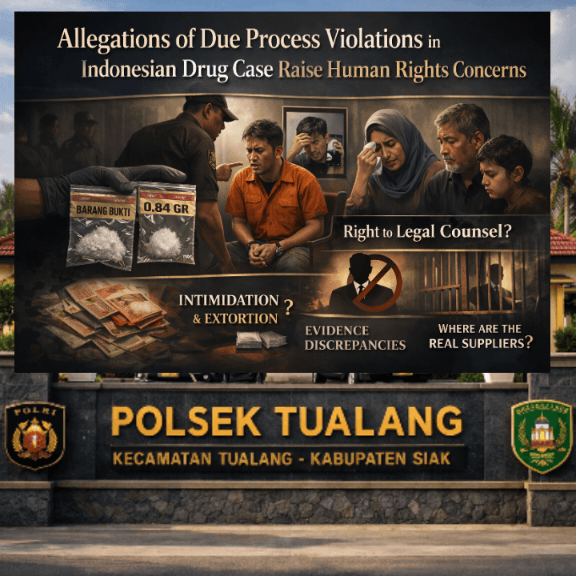
Mataxpost | Tualang, Siak – Indonesia Allegations of procedural misconduct in a drug case handled by Polsek Tualang have sparked growing public scrutiny and raised broader concerns about due process and human rights protections within Indonesia’s criminal justice system. (28/02)
The case involves a man identified only as “B,” who was arrested on January 26, 2026, at his workplace. What initially appeared to be a routine narcotics arrest has evolved into a controversy involving allegations of intimidation, denial of effective legal counsel, inconsistencies in evidence handling, and failure to pursue alleged higher-level sources of drug distribution.

Right to Legal Counsel Under Question
According to family members, B had no prior criminal record and was unfamiliar with legal procedures.
The day after his arrest, relatives informed investigators that they intended to appoint a private lawyer to assist him and formally requested rehabilitation, arguing that B was a drug user rather than a trafficker.
However, the family alleges that investigators objected to the involvement of external legal counsel and encouraged them to leave the process entirely to police authorities.

Under Indonesia’s Criminal Procedure Code (KUHAP), suspects have the right to legal assistance at every stage of examination. When facing charges carrying a minimum sentence of five years or more, legal representation is mandatory.
B has been charged under Article 114(1) of Undang-Undang Nomor 35 Tahun 2009 tentang Narkotika, which pertains to drug trafficking offenses and carries a minimum sentence of five years and a maximum of twenty years, along with substantial financial penalties.
Given the severity of the charge, effective legal representation is not optional it is a legal safeguard.
Yet the family claims that although a lawyer’s name appears in the official interrogation record (BAP), they never appointed that individual.
B reportedly told relatives that he was not physically accompanied by counsel during questioning and that any alleged “assistance” occurred via an unclear video call on an investigator’s phone, without meaningful participation.
If accurate, such circumstances could raise serious questions regarding compliance with domestic procedural law and international fair trial standards, including principles enshrined in the International Covenant on Civil and Political Rights (ICCPR), to which Indonesia is a state party.
Alleged Intimidation and Pressure
Further allegations deepen the human rights concerns.
B reportedly told his family that he was warned his case would be “made more difficult” if his family insisted on using an outside lawyer. The alleged statement, according to B, was made in the presence of the unit chief investigator.
The family also alleges financial coercion: B was reportedly told he would have to compensate approximately 65 million rupiah (around USD 4,000) for a vehicle linked to the arrest if he did not comply with investigators’ directions.
Additionally, his employer was allegedly asked to pay 10 million rupiah for the vehicle’s release. If proven, such actions could constitute abuse of authority or extortion under Indonesian criminal law.
More broadly, any intimidation or coercion during investigation raises red flags under international human rights standards prohibiting pressure, threats, or undue influence in custodial settings.
Discrepancies in Evidence
Another issue drawing attention is the reported change in the weight of the seized narcotics from 0.6 grams to 0.84 grams after the case gained public attention.
While both quantities remain under one gram, the distinction is not trivial.
In Indonesian judicial practice, guidance from the Supreme Court including SEMA Nomor 3 Tahun 2011 allows for rehabilitation considerations in cases involving small quantities intended for personal use, provided there is no proven involvement in drug distribution networks.
Inconsistencies in recorded evidence, if unexplained, may undermine confidence in the integrity of the evidentiary process.
Questions About Broader Accountability
The family also alleges that the narcotics were obtained through intermediaries connected to an incarcerated individual identified only as “Ted.” To date, they claim, no visible investigative steps have been taken against that alleged source.
Failure to pursue alleged upstream actors, if substantiated, may raise concerns about selective enforcement and the broader integrity of anti-narcotics operations.
A Matter Beyond One Case
This case now extends beyond the fate of a single defendant.
Human rights advocates frequently emphasize that the earliest stages of criminal investigation are decisive. If access to counsel is restricted, if intimidation occurs, or if evidence documentation is inconsistent, the fairness of the entire judicial process may be called into question.
The family has announced plans to submit formal complaints to internal police oversight bodies, national supervisory institutions, and human rights authorities, seeking an independent review and supervised case examination.
As of publication, no official clarification has been issued by the police or by individuals named in the allegations.
Trust at Stake If these allegations are ultimately substantiated, the consequences would extend beyond one courtroom.
Public trust in law enforcement institutions depends not only on the punishment of wrongdoing but on the integrity of the process itself.
The rule of law requires that even those accused of crimes are treated with dignity, afforded effective legal representation, and protected from coercion.
For many observers, the central question is simple yet profound: when the law is meant to protect the vulnerable, what happens when those protections are themselves questioned?
The family insists they are not seeking special treatment only a fair process, respect for legal rights, and justice free from intimidation.
This publication remains committed to the principles of balance, presumption of innocence, and the right of reply. All parties mentioned are invited to provide clarification or response.

Pos terkait









Latest Post


 .
.
 .
.
 .
.


Tidak ada komentar