

 .
.
 .
.
 .
.
 .
.
 .
.
 .
.
Dictators and War Crimes: A Global Accountability Crisis
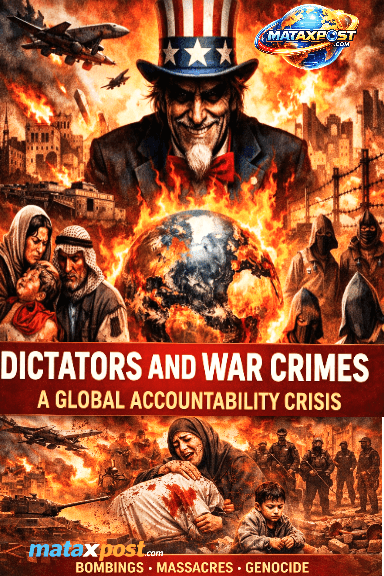
Mataxpost | Riau,Indonesia,- The world is no longer lacking evidence. What it lacks is the courage to act, The dominance of the United States in global conflicts is no longer merely a geopolitical issue it has evolved into a central point of criticism regarding international justice. (23/03)
With military, economic, and political power surpassing that of many nations, its role extends beyond participation in conflicts to actively shaping the direction of global dynamics.

For decades, U.S. foreign policy has shaped the landscape of global conflict from the Middle East to Latin America. Military interventions, economic pressure, and political operations have been carried out in the name of stability and security.
Yet behind this narrative, what is often left behind is destroyed infrastructure, civilian casualties, and prolonged instability that weakens affected nations.
In the Middle East, escalating tensions between Iran, Israel, and the United States once again reveal a recurring pattern: strikes on strategic targets, cross-border escalation, and rising risks of regional crisis.

The impact extends beyond the battlefield, threatening global stability, including vital energy routes such as the Strait of Hormuz.
However, the core issue is not merely conflict it is its consequences. Over decades of military operations, civilian casualties and humanitarian crises have repeatedly emerged. From one region to another, the pattern remains the same: instability, prolonged conflict, and increasingly fragile states.
The term “war criminal” is no longer just rhetorical it is becoming a form of global protest against what is perceived as systemic impunity. Under international law, actions that result in large-scale civilian harm should trigger serious legal consequences. Yet in practice, such mechanisms often fail to apply equally to powerful states.
When other nations commit violations, global responses tend to be swift and decisive sanctions are imposed, pressure is intensified, and legitimacy is withdrawn. In contrast, when major powers act similarly, responses are often delayed, weakened, or absent.
It is here that double standards cease to be hidden and instead become an entrenched reality within the international system.
The irony deepens as the United States actively labels other nations or leaders as dictators, human rights violators, or global threats, while at the same time being seen as avoiding accountability for its own actions.
In this context, international law no longer functions purely as an instrument of justice, but also as a tool of political interest.
Beyond military conflict, pressure is also exerted through economic sanctions, diplomatic isolation, and political intervention.
Countries such as Venezuela demonstrate how non-military pressure can still produce significant humanitarian consequences, directly affecting civilian populations without a single shot being fired.
Moreover, dominance in global information flows reinforces this position. Narratives of “stability” and “security” often shape global perception, creating legitimacy that does not always align with universal principles of justice. In such conditions, perception is not determined solely by facts, but by those who control the narrative.
The role of the United Nations as the guardian of global order is now under scrutiny. Its inability to consistently enforce principles of justice raises serious doubts about the effectiveness of international law. Without equal enforcement, the law risks losing its legitimacy in the eyes of the world.
This situation reveals that the problem is not merely the actions of a single nation, but a global system that allows such imbalances to persist. The world is gradually being confronted with a reality where power can stand above the law.
Yet history has shown one constant: no dominance endures without challenge. Calls for change are growing louder, demanding consistent enforcement of international law, respect for national sovereignty, and accountability without exception.
The world now stands at a crossroads: maintain a system defined by double standards, or move toward a truly just and equal international order.
Global pressure through diplomacy, international law, and solidarity among nations remains a crucial instrument to ensure that no power is immune from the same rules.
Because when the law applies only to the weak, the powerful do not merely rule they become untouchable.
And when that happens, the world is not preserving peace. It is allowing injustice to become the system.

Pos terkait






Latest Post


 .
.
 .
.
 .
.
 .
.
 .
.
 .
.
 .
.
 .
.
 .
.
 .
.

Tidak ada komentar